
The Dual-Write Catastrophe in Distributed Architecture
One of the most insidious architectural traps in modern microservice systems is the Dual-Write Problem. Consider a seemingly standard e-commerce checkout flow:
// ANTI-PATTERN: The Brittle Dual-Writefunc ProcessOrder(ctx context.Context, order Order) error { // 1. Commit transaction to PostgreSQL err := db.Exec("INSERT INTO orders (id, amount) VALUES ($1, $2)", order.ID, order.Amount) if err != nil { return err }
// 2. Publish event to Apache Kafka broker err = kafkaProducer.Send(ctx, "orders.created", order.ID, order) if err != nil { // CATASTROPHE: Database transaction succeeded, but message was lost! // Downstream Inventory and Billing services will never know this order exists. return err } return nil}Reversing the order doesn’t help: if the Kafka publish succeeds but the database transaction rolls back due to a constraint violation or network partition, you emit a ghost event into the cluster, billing customers for nonexistent orders.
In distributed computing without complex and slow two-phase commit (2PC) protocols, writing to two independent stateful systems within a single application thread cannot guarantee atomicity.
1. The Transactional Outbox Pattern
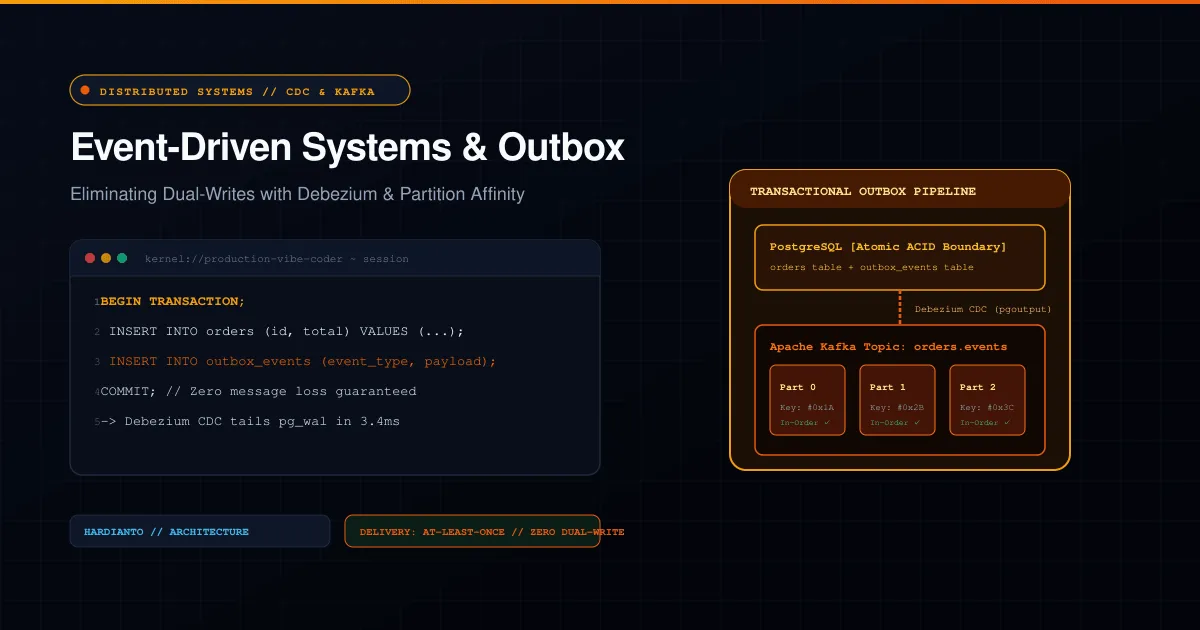
The industry standard solution is the Transactional Outbox Pattern. Rather than publishing directly to an external message broker, the application writes the domain entity and an integration event into the same relational database within a single local ACID transaction.
+-----------------------------------------------------------------------------------+| TRANSACTIONAL OUTBOX ARCHITECTURE |+-----------------------------------------------------------------------------------+| || [Microservice Application Boundary] || +-----------------------------------------------------------------------------+ || | BEGIN TRANSACTION; | || | INSERT INTO orders (id, user_id, amount) VALUES (...); | || | INSERT INTO outbox_events (id, aggregate_id, event_type, payload) VALUES (...); || | COMMIT; | || +-----------------------------------------------------------------------------+ || | || v || +-----------------------------------------+ || | PostgreSQL Primary (WAL Enabled) | || | [orders table] [outbox_events table] | || +-----------------------------------------+ || | |+---------|-------------------------------------------------------------------------+ | Logical Replication Stream (pgoutput plugin) v+----------------------------------------------------+| Debezium CDC (Change Data Capture) Engine || Reads database Write-Ahead Log without polling |+----------------------------------------------------+ | v Guaranteed At-Least-Once Delivery+----------------------------------------------------+| Apache Kafka Topic: `production.orders.events` || [Partition 0] [Partition 1] [Partition 2] |+----------------------------------------------------+PostgreSQL Outbox Table Schema
CREATE TABLE outbox_events ( id UUID PRIMARY KEY DEFAULT gen_random_uuid(), aggregate_type VARCHAR(64) NOT NULL, aggregate_id VARCHAR(64) NOT NULL, event_type VARCHAR(128) NOT NULL, payload JSONB NOT NULL, created_at TIMESTAMPTZ NOT NULL DEFAULT NOW());
-- Enable Change Data Capture through PostgreSQL Logical ReplicationALTER TABLE outbox_events REPLICA IDENTITY FULL;With Debezium, an external connector tails the PostgreSQL Write-Ahead Log (WAL) directly using logical replication slots (pgoutput). When an outbox row commits, Debezium streams it into Apache Kafka with zero database query polling overhead and sub-10ms delivery latency.
2. Apache Kafka Partitioning: In-Order Sequencing
A common distributed systems pitfall is losing sequential message order. If a customer emits OrderCreated, OrderAddressUpdated, and OrderCanceled in rapid succession, processing these events out of order results in shipping an order that was canceled!
Apache Kafka guarantees total ordering only within a single partition.
[Kafka Topic: orders] Hashing Formula: murmur2(AggregateKey) % num_partitions ------------------------------------------------------- Tenant A / User 1024 -------------> [Partition 0] (Strict In-Order) Tenant B / User 2048 -------------> [Partition 1] (Strict In-Order) Tenant C / User 4096 -------------> [Partition 2] (Strict In-Order)Partition Key Hashing Strategy
Always set the Kafka record key to the unique identifier of the entity aggregate (such as order_id or account_id). Kafka’s default partitioner hashes this key via murmur2, ensuring all events pertaining to that specific aggregate land sequentially on the exact same broker partition.
// Publishing with explicit partition key alignmentmsg := &kafka.Message{ TopicPartition: kafka.TopicPartition{ Topic: &topic, Partition: kafka.PartitionAny, // Let Kafka hash the Key }, Key: []byte(order.ID.String()), // Guarantees all events for this order stay in order Value: eventPayloadJSON, Headers: []kafka.Header{ {Key: "eventType", Value: []byte("OrderCreated")}, {Key: "traceId", Value: []byte(traceID)}, },}3. Designing Idempotent Consumers
In distributed systems, the network will inevitably retry requests. Network timeouts, consumer group rebalancing, or container crashes mean your consumer must adhere to At-Least-Once Delivery semantics.
Your business logic must be strictly Idempotent: executing the same event twice must yield the exact same end state without duplicate side-effects.
-- Idempotency Registry Table in Consumer ServiceCREATE TABLE processed_events ( event_id UUID PRIMARY KEY, consumer_group VARCHAR(64) NOT NULL, processed_at TIMESTAMPTZ NOT NULL DEFAULT NOW());func (c *OrderConsumer) HandleMessage(ctx context.Context, msg *kafka.Message) error { eventID := extractHeader(msg, "eventId")
// Begin consumer local database transaction tx, err := c.db.Begin(ctx) if err != nil { return err } defer tx.Rollback(ctx)
// Check & insert idempotency record with ON CONFLICT DO NOTHING res, err := tx.Exec(ctx, ` INSERT INTO processed_events (event_id, consumer_group) VALUES ($1, $2) ON CONFLICT (event_id) DO NOTHING `, eventID, c.consumerGroup) if err != nil { return err }
// If no row was inserted, this event was already processed! if res.RowsAffected() == 0 { log.Printf("Duplicate event skipped: %s", eventID) return nil // Acknowledge message safely }
// Process actual domain logic if err := c.applyOrderUpdate(ctx, tx, msg.Value); err != nil { return err }
return tx.Commit(ctx)}Important (Production Rule: Business Keys vs Synthetic Event IDs)
Do not rely solely on UUIDs generated at the message broker boundary. Whenever possible, derive idempotency keys from unique domain combinations, such as hash(order_id + payment_attempt_number). This ensures that even if an upstream service re-emits an event with a new envelope ID, duplicate operations are blocked.
4. Dead Letter Queues (DLQ) and Exponential Backoff Retries
When a consumer encounters a processing failure, simply crashing in a loop halts partition processing for all subsequent customers behind the failing message (a phenomenon known as Head-of-Line Blocking).
Production event systems utilize a Tiered Retry and Dead Letter Queue (DLQ) topology:
[Main Topic: orders] | v Error Encountered (e.g., Payment Gateway Timeout)+------------------------------------------+| Retry Topic 1 (Delay: 5 Seconds) |+------------------------------------------+ | Fail again v+------------------------------------------+| Retry Topic 2 (Delay: 60 Seconds) |+------------------------------------------+ | Max retries exceeded (e.g., 3 attempts) v+------------------------------------------+| Dead Letter Queue (DLQ: orders-dlq) | --> Alarms trigger, ops team investigates+------------------------------------------+- Transient Failures (Network timeouts, downstream 503 errors): Route to retry topics with exponential backoff headers.
- Permanent Poison Pill Failures (Corrupt JSON payloads, null constraint violations): Forward directly to the
DLQimmediately to keep the main processing pipeline flowing.
Architectural Guidelines
- Never perform dual-writes: Use the Transactional Outbox pattern backed by PostgreSQL WAL logical replication and Debezium.
- Enforce Partition Affinity: Key all events with the aggregate entity ID to guarantee FIFO order per entity.
- Design for Idempotency: Maintain a persistent deduplication table within the consumer’s target transaction boundary.
- Isolate Poison Pills: Utilize Dead Letter Queues with retry headers to prevent unrecoverable messages from blocking entire consumer partitions.
Recommended for You
Explore more articles on similar topics and continue reading.
PostgreSQL Performance Tuning at Scale: Indexing Strategies, Buffer Cache, and Connection Pooling

Computer Science 2026: Paradigms, Hardware Frontiers, and Distributed Resilience