

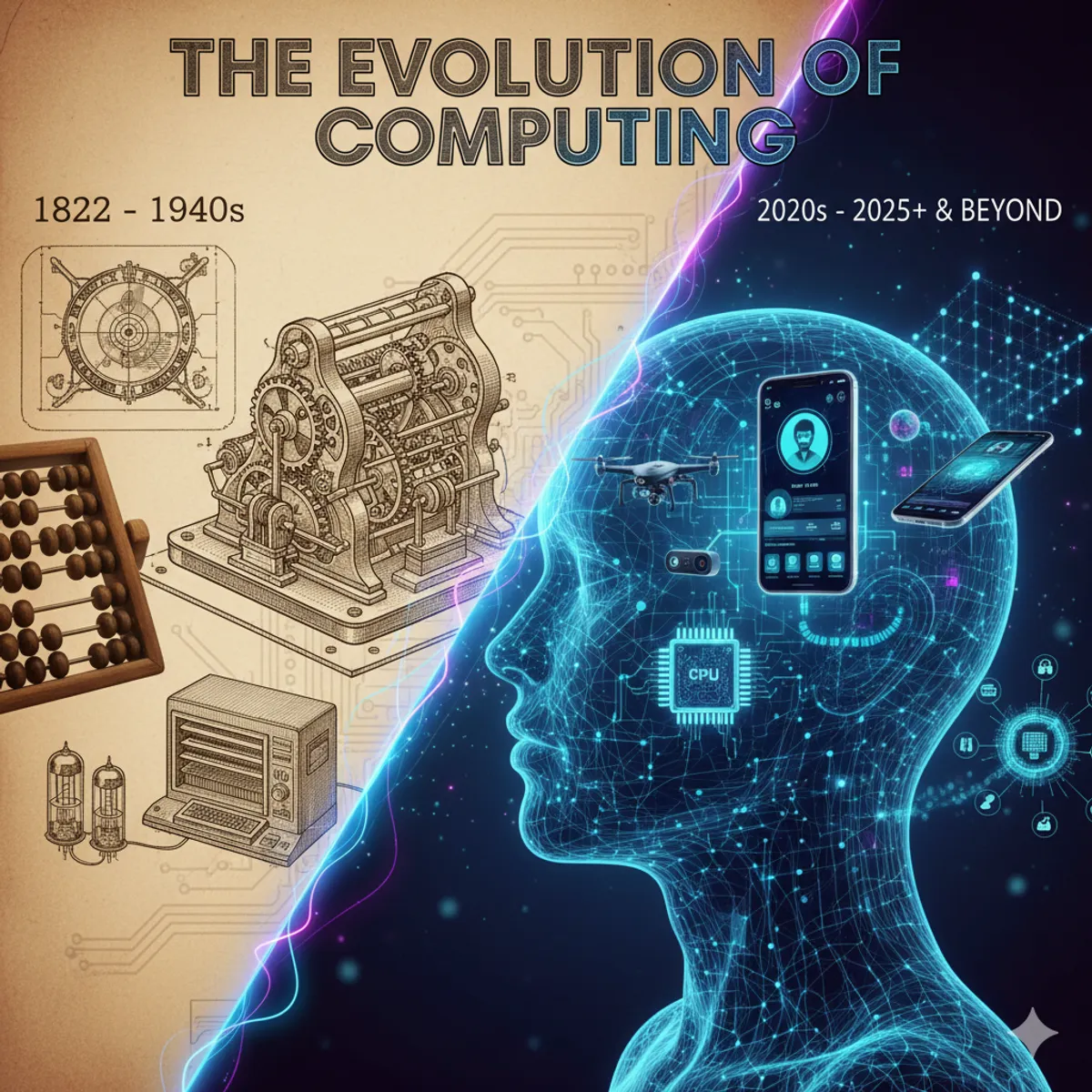
The Relentless March of Human Computation
The history of computing is not merely an engineering timeline; it is the progressive mechanization of mathematical thought. Over two centuries, human civilization has transitioned from steam-driven brass gears and fragile thermionic vacuum tubes to nanometer-scale photolithography and coherent quantum states.
Understanding how we arrived at modern heterogeneous supercomputers requires dissecting the five distinct architectural epochs that shaped computing reality.
Epoch 1: Mechanical Precursors and the Birth of Theoretical Computation (1830s–1940s)
Before electricity was harnessed for logic gates, computation was purely physical:
- Charles Babbage & The Analytical Engine (1837): Babbage conceptualized the first Turing-complete design, featuring a “Mill” (CPU), a “Store” (Memory), and punched-card input inspired by the Jacquard loom.
- Ada Lovelace’s Algorithmic Insight (1843): Lovelace wrote the first published algorithm (computing Bernoulli numbers) and recognized that machines could manipulate any symbols governed by rules—not just numerical values.
- Alan Turing and the Universal Turing Machine (1936): Turing formulated the mathematical definition of computation, proving that a single abstract machine with an infinite tape and a transition table could simulate any formal computation (the Church-Turing thesis).
- Claude Shannon’s Symbolic Synthesis (1937): Shannon’s master’s thesis proved that electrical switches and relays could solve Boolean algebraic logic, cementing binary logic (0 and 1) as the universal language of electronic computers.
Epoch 2: The Vacuum Tube and the Stored-Program Architecture (1940s–1950s)
World War II catalyzed the creation of electronic digital computation:
- ENIAC (Electronic Numerical Integrator and Computer, 1945): Built at the University of Pennsylvania by John Mauchly and J. Presper Eckert. Composed of 17,468 vacuum tubes, ENIAC operated at 100,000 pulses per second. However, “programming” required manually rewiring massive plugboards and setting rotary switches over days.
- The First Draft of a Report on the EDVAC (John von Neumann, 1945): Formulated the canonical Von Neumann Architecture:
- Central Processing Unit (Arithmetic Logic Unit + Registers).
- Control Unit (Instruction Register + Program Counter).
- Unified Memory storing both instructions and operands.
- Input / Output mechanisms.
- Manchester Baby (SSEM, 1948): The world’s first stored-program computer to successfully execute code loaded from memory, validating Von Neumann’s thesis.
Important (The Von Neumann Bottleneck)
Because instructions and data share the same physical bus, the maximum throughput of a Von Neumann machine is bounded by the bandwidth between the CPU and memory. This memory wall remains one of the greatest challenges in computer engineering today.
[Classical Von Neumann Architecture] [Modern Heterogeneous Architecture]+-----------------------------------+ +-----------------------------------+| Central Processing Unit | | Host CPU (OS, Scheduling, Logic) || +-----------------------------+ | +-----------------+-----------------+| | Arithmetic Logic Unit (ALU) | | | PCIe 5.0 / CXL Bus| +-----------------------------+ | v| | Control Unit (Decoder) | | +-----------------+-----------------+| +-----------------------------+ | | Domain-Specific Accelerators || | Registers / L1-L3 Cache | | | +---------------+ +-------------+ || +-----------------------------+ | | | SIMD Shaders | | Tensor Core | |+-----------------+-----------------+ | +---------------+ +-------------+ | | Shared Bus | | On-package HBM3e (3.2 TB/s) | | v | +-------------------------------+ |+-----------------------------------+ +-----------------------------------+| Main Memory (Shared Data & Code) |+-----------------------------------+Epoch 3: Solid-State Physics, Microprocessors, and the PC Revolution (1950s–1990s)
The vacuum tube was physically fragile and consumed immense power. The solid-state revolution replaced mechanical thermionic emission with semiconductor quantum physics:
- The Point-Contact Transistor (1947): Invented by John Bardeen, Walter Brattain, and William Shockley at Bell Labs. Transistors controlled electrical current using solid silicon/germanium without vacuum tubes or moving parts.
- The Monolithic Integrated Circuit (1958/1959): Jack Kilby (Texas Instruments) and Robert Noyce (Fairchild Semiconductor) integrated multiple transistors, resistors, and capacitors onto a single piece of semiconductor substrate.
- Intel 4004 (1971): Designed by Federico Faggin, Ted Hoff, and Masatoshi Shima. The first commercial single-chip central processing unit, containing 2,300 transistors on a 10-micrometer process running at 740 kHz.
- The Architectural Duel: RISC vs. CISC:
- CISC (Complex Instruction Set Computer): Exemplified by x86 (Intel 8086). Aimed to reduce compiler complexity with dense, multi-cycle instructions.
- RISC (Reduced Instruction Set Computer): Championed by Patterson (Berkeley) and Hennessy (Stanford). Simplified instructions to execute in a single clock cycle, enabling deep pipelining. Modern ARM and Apple Silicon architectures demonstrate the enduring power efficiency of RISC principles.
| Era | Representative Machine | Primary Switching Element | Typical Operations/Sec |
|---|---|---|---|
| Mechanical (1940s) | Harvard Mark I / Zuse Z3 | Electromechanical relays | 3–5 ops/sec |
| First Generation (1946–1955) | ENIAC / UNIVAC I | Vacuum tubes | 5,000 additions/sec |
| Second Generation (1955–1964) | IBM 7090 | Discrete transistors | 200,000 ops/sec |
| Third Generation (1964–1971) | IBM System/360 | Small/Medium Scale ICs | 1,000,000+ ops/sec (1 MIPS) |
| Fourth Generation (1971–Present) | Intel Core i9 / Apple M-series | 3nm Gate-All-Around FinFETs | Billions to Trillions (Teraflops) |
Epoch 4: Heterogeneous Computing and Domain-Specific Accelerators (2010s–2025)
By 2005, Dennard scaling had collapsed: shrinking transistors no longer kept power density constant, causing single-core clock speeds to plateau around 3–5 GHz. Computer architecture responded by pivoting from instruction-level parallelism to thread- and data-level parallelism:
- General-Purpose Computing on GPUs (GPGPU): NVIDIA’s release of CUDA (2006) transformed graphics cards from fixed-function video rasterizers into massively parallel tensor engines with thousands of SIMD cores.
- Domain-Specific Architectures (DSAs): Google’s TPU (Tensor Processing Unit), Apple’s Neural Engine, and Groq’s LPU (Language Processing Unit). These chips sacrifice general OS execution capability to maximize matrix multiplication throughput per watt.
- 3D Packaging & High-Bandwidth Memory (HBM3e): Modern accelerators stack DRAM dies directly on top of silicon interposers, achieving terabytes-per-second of memory bandwidth.
Epoch 5: The Quantum Horizon
Classical computing represents information using deterministic binary digits ( or ). Quantum Computing exploits the counter-intuitive principles of quantum mechanics:
- Superposition: A quantum bit (qubit) can exist in a linear combination of states , where . An -qubit register can simultaneously represent computational states.
- Entanglement: Qubits can become mathematically linked such that the quantum state of one instantly dictates the state of another, irrespective of physical distance.
- Interference: Quantum algorithms (such as Shor’s algorithm for prime factorization and Grover’s algorithm for unstructured database search) orchestrate probability amplitudes so that incorrect paths destructively interfere and cancel out, while the correct answer constructively amplifies.
Tip (NISQ Era vs. Fault-Tolerant Quantum Computing)
Today we inhabit the Noisy Intermediate-Scale Quantum (NISQ) era. Qubits are prone to environmental decoherence. The ultimate milestone is Fault-Tolerant Quantum Computing, using topological surface codes where thousands of physical qubits unite into a single logical, error-corrected qubit.
Conclusion: Computation as a Natural Force
From Charles Babbage’s gear trains to subatomic quantum circuits, the definition of a computer has continually expanded. As we move deeper into the 21st century, the boundary between hardware, mathematics, and natural biology continues to blur. We are discovering that computing is not merely an invention of human engineering—it is a fundamental property of the physical universe itself.
Recommended for You
Explore more articles on similar topics and continue reading.
Artificial Intelligence: From Foundational Models to Autonomous Agentic Systems
Computer Science 2026: Paradigms, Hardware Frontiers, and Distributed Resilience