The Great Convergence: Physics, Silicon, and Algorithmic Theory
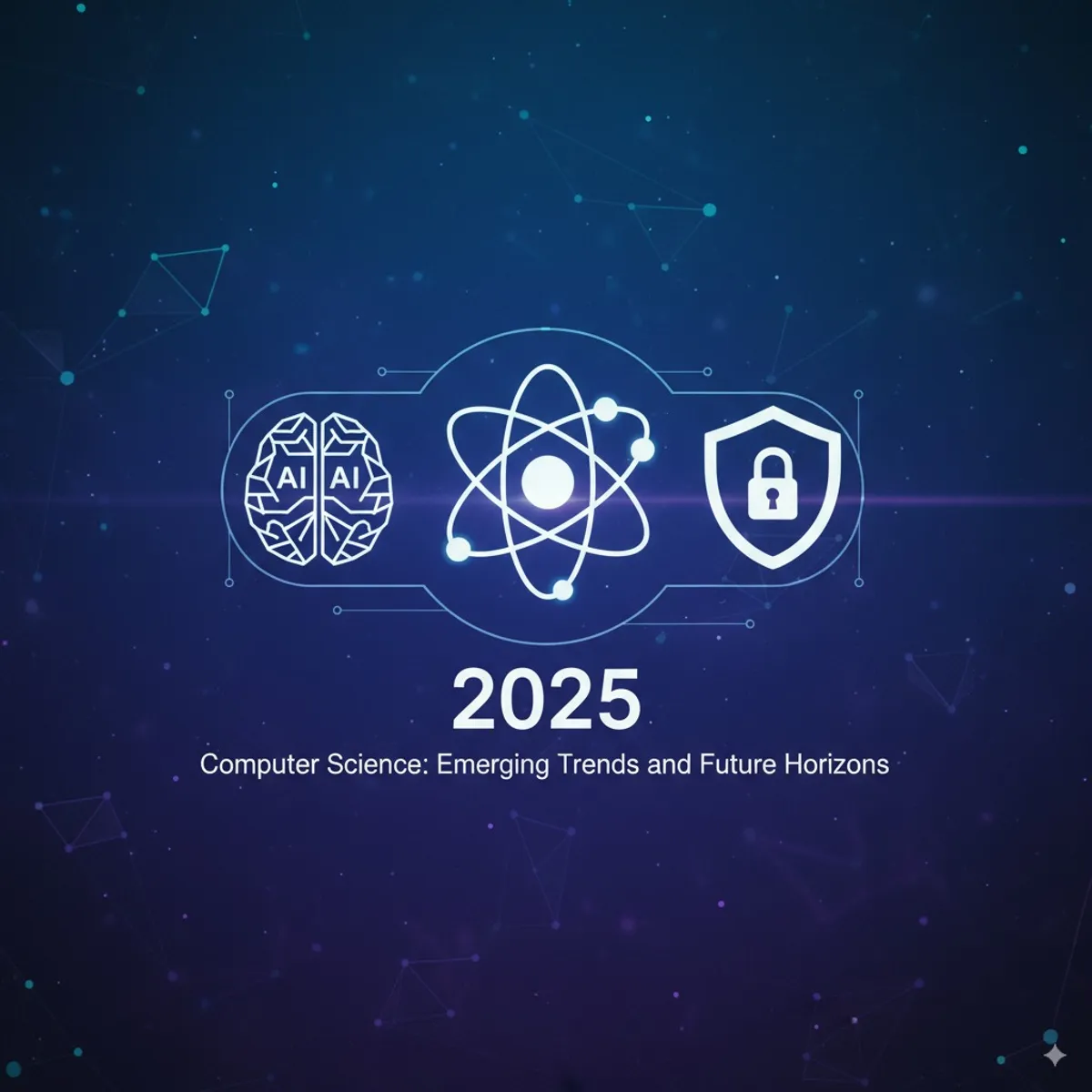
The field of Computer Science in 2025 is defined by a fundamental shift: the historical decoupling between abstract software layers and underlying physical hardware has dissolved. As silicon manufacturing approaches atom-scale physical limits (sub-2nm gate-all-around nodes) and standard classical cryptography faces existential quantum challenges, computer scientists are forced to architect solutions across the entire vertical stack—from quantum-resistant mathematics and custom neural silicon to real-time spatial coordinate engines.
Definition (The End of Moore's Law as Pure Frequency Scaling)
While transistor density continues through 3D chiplet stacking and High-NA EUV lithography, single-thread clock frequencies remain constrained by thermal dissipation limits (the “power wall”). Performance gains in 2025 originate almost entirely from architectural domain specialization, memory bandwidth topology (HBM3e/CXL), and heterogeneous parallel accelerators.
Frontier 1: Spatial Computing and Real-Time Perception Pipelines
Spatial computing has matured from experimental virtual headsets into an established discipline of computer vision, embedded sensor fusion, and low-latency graphics pipelines.
The Real-Time SLAM Pipeline
Simultaneous Localization and Mapping (SLAM) is the algorithmic core of spatial computing, autonomous robotics, and mixed-reality headsets. The challenge is computing 6-DoF (Degrees of Freedom) tracking within an unfamiliar physical volume while maintaining a sub-15ms motion-to-photon latency budget:
+-----------------------------------------------------------------------+| Spatial Real-Time SLAM & Rendering Pipeline || || [Stereo Cameras (90-120Hz)] [IMU Accelerometer/Gyro (1kHz)]|| | | || v v || +--------------------------+ +-------------------------+ || | FAST Corner Extraction | | High-rate Pre-integrat. | || | & Deep Learned Descr. | | (Discrete Runge-Kutta) | || +------------+-------------+ +------------+------------+ || | | || +------------------+------------------+ || v || +---------------------------------------------------------------+ || | Visual-Inertial Odometry (VIO) / Factor Graph Engine | || | State: [Position p, Velocity v, Orientation q, Gyro/Acc Bias] | || +-------------------------------+-------------------------------+ || | Current 6-DoF Pose (<10ms) || v || +---------------------------------------------------------------+ || | Loop Closure & 3D Gaussian Splatting Rasterizer | || | - NetVLAD Global Place Recogn. - Sort & Tile Alpha Blending | || +---------------------------------------------------------------+ || | || v || [Low-Persistence Micro-OLED 4K Display (120 FPS)] |+-----------------------------------------------------------------------+- Feature Extraction: Real-time extraction of FAST corners or learned feature points from dual high-framerate global shutter cameras.
- Visual-Inertial Odometry (VIO): Fusing high-frequency IMU accelerometer/gyroscope telemetry (1000 Hz) with camera keyframes (90–120 Hz) via an Extended Kalman Filter (EKF) or Factor Graph Optimization.
- Loop Closure & Global Relocalization: Detecting previously visited locations via deep visual embeddings (e.g., NetVLAD) to counteract cumulative drift errors.
// Conceptual Visual-Inertial Fusion Loop (C++20 Pseudo-Architecture)struct IMUSample { double timestamp; Vector3d angular_velocity; Vector3d linear_acceleration;};
struct CameraFrame { double timestamp; cv::Mat raw_image; std::vector<cv::KeyPoint> keypoints;};
class SpatialTracker {public: void process_imu(const IMUSample& imu) { // High-rate state propagation using Runge-Kutta numerical integration state_estimator_.propagate_nominal_state(imu.linear_acceleration, imu.angular_velocity, imu.timestamp); }
void process_frame(const CameraFrame& frame) { // Bundle adjustment update: minimize reprojection error across active map landmarks auto residual = optimizer_.compute_reprojection_residuals(frame, state_estimator_.current_pose()); if (residual.has_converged()) { state_estimator_.update_covariance(residual); } }private: StateEstimator state_estimator_; FactorGraphOptimizer optimizer_;};3D Gaussian Splatting and Dynamic Occlusion
While traditional graphics rely on polygon rasterization, spatial computing in 2025 heavily integrates 3D Gaussian Splatting (3DGS). By representing environments as millions of differentiable 3D ellipsoids, engines render photorealistic radiance fields at native 90+ FPS on embedded mobile GPUs, enabling seamless physical-to-virtual lighting and real-time hand-occlusion matrices.
Frontier 2: Neuromorphic Computing and Alternative Substrates
As traditional Von Neumann architectures suffer from memory bandwidth bottlenecks (transferring data continuously between CPU registers and DRAM), Neuromorphic Computing introduces non-Von Neumann, event-driven architectures inspired by biological nervous systems.
Important (Spiking Neural Networks (SNNs) vs. Traditional ANNs)
Traditional Artificial Neural Networks evaluate continuous floating-point activations across all nodes synchronously every cycle. In contrast, Spiking Neural Networks (SNNs) communicate asynchronously via discrete temporal pulses (“spikes”). If there is no change in sensory input, zero energy is expended.
| Metric | Standard GPUs / TPUs | Neuromorphic Silicon (e.g., Intel Loihi 2) |
|---|---|---|
| Execution Model | Synchronous dense tensor multiplication | Asynchronous event-driven spike trains |
| Memory Architecture | Separated HBM/SRAM (Memory bus bottleneck) | Colocated processing-in-memory (PIM) synapses |
| Power Efficiency (Idle/Sparse) | High static idle dissipation (100W – 700W) | Sub-milliwatt power draw during sensory sparsity |
| Primary Workloads | Dense LLM pre-training, batch inference | Continuous edge audio/gesture tracking, robotic feedback |
Frontier 3: Post-Quantum Cryptography (PQC) Transition
The commercial advent of Cryptographically Relevant Quantum Computers (CRQCs) threatens to break the mathematical foundations of modern public-key infrastructure—specifically RSA (integer factorization) and ECDSA (discrete logarithms) via Shor’s Algorithm.
The NIST PQC Standardized Algorithms (FIPS 203, 204, 205)
In August 2024, the US National Institute of Standards and Technology (NIST) officially released the final federal standards for post-quantum algorithms:
- ML-KEM (FIPS 203 / formerly Kyber): A Module Lattice-based Key-Encapsulation Mechanism designed for establishing shared symmetric keys across TLS sessions.
- ML-DSA (FIPS 204 / formerly Dilithium): A Module Lattice-based Digital Signature Algorithm for code signing, certificates, and identity verification.
- SLH-DSA (FIPS 205 / formerly SPHINCS+): A Stateless Hash-based Digital Signature Algorithm serving as a mathematical hedge against any future breakthroughs in lattice cryptanalysis.
Danger (The "Harvest Now, Decrypt Later" Threat Vector)
Nation-state threat actors are currently intercepting and archiving petabytes of encrypted TLS traffic across transoceanic backbones. The strategic goal: hold the ciphertext until quantum computers scale, subsequently decrypting years of confidential government cables, proprietary patents, and banking records.
Implementing Hybrid Key Exchange in TLS 1.3
To guarantee zero regression in baseline security, enterprise software engineering has adopted hybrid key encapsulation: pairing a classical elliptic-curve algorithm (X25519) with a post-quantum lattice algorithm (ML-KEM-768). An adversary must break both mathematical problems simultaneously to compromise the session.
| Algorithm & Role | Underlying Math Problem | Public Key Size | Ciphertext / Sig Size | Quantum Security |
|---|---|---|---|---|
| ML-KEM-768 (FIPS 203) | Module Learning-with-Errors (M-LWE) | 1,184 Bytes | 1,088 Bytes | NIST Level 3 (AES-192 equivalent) |
| ML-DSA-65 (FIPS 204) | Module Short Integer Solution (M-SIS) | 1,952 Bytes | 3,309 Bytes | NIST Level 3 (AES-192 equivalent) |
| Classical RSA-3072 | Integer Factorization | 384 Bytes | 384 Bytes | Vulnerable to Shor’s Algorithm |
| Classical ECDSA (P-256) | Elliptic Curve Discrete Logarithm | 64 Bytes | 64 Bytes | Vulnerable to Shor’s Algorithm |
Frontier 4: Distributed Consensus and Verifiable Systems
Distributed systems in 2025 must reconcile extreme geographic dispersion with Byzantine fault tolerance. Key advancements include:
- Formal Specification via TLA+: Modern distributed storage engines (e.g., distributed consensus engines, cloud hyper-scalers) routinely write mathematical proofs in TLA+ to formally eliminate concurrency deadlocks and split-brain phenomena before a single line of production code is written.
- Conflict-Free Replicated Data Types (CRDTs): State-based (CvRDT) and Operation-based (CmRDT) structures are powering real-time local-first collaborative applications, providing mathematically guaranteed eventual consistency without centralized database locking.
- Zero-Knowledge Proofs (zk-SNARKs/STARKs): Beyond cryptocurrency, zero-knowledge verifiable computation is being used to verify outsourced cloud database queries and validate AI model execution integrity without leaking sensitive training data.
Conclusion: The Horizon of Modern Computing
The computer scientist of 2025 is no longer merely a software engineer building on top of predictable, isolated abstractions. The contemporary discipline requires an understanding of physical energy constraints, lattice-based mathematical proofs, asynchronous hardware execution, and distributed Byzantine resilience. As we advance into the late 2020s, computer science is reaffirming its identity as both a fundamental mathematical science and an empirical physical discipline.
Recommended for You
Explore more articles on similar topics and continue reading.
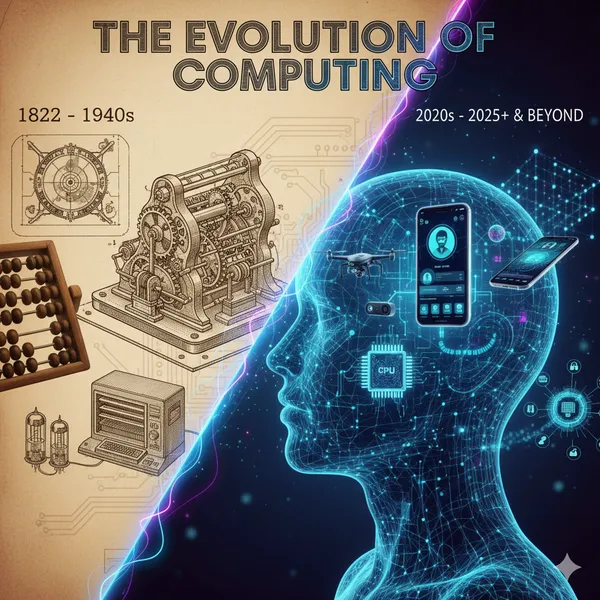
The Evolution of Computing: From Mechanical Engines to Quantum Coherence

Artificial Intelligence: From Foundational Models to Autonomous Agentic Systems