
The Maintenance Window Is Dead
In high-concurrency 24/7 web platforms, the concept of scheduled maintenance windows—halting user traffic at 2:00 AM on Sunday to run ALTER TABLE users RENAME COLUMN email TO contact_email—is an unacceptable anti-pattern.
Relational databases like PostgreSQL, MySQL, and MariaDB acquire heavyweight table locks (ACCESS EXCLUSIVE) during naive schema alterations. If an ALTER TABLE statement waits behind a long-running analytical query, every subsequent read and write query on that table queues behind it, exhausting the application connection pool within seconds and triggering a catastrophic cascading outage.
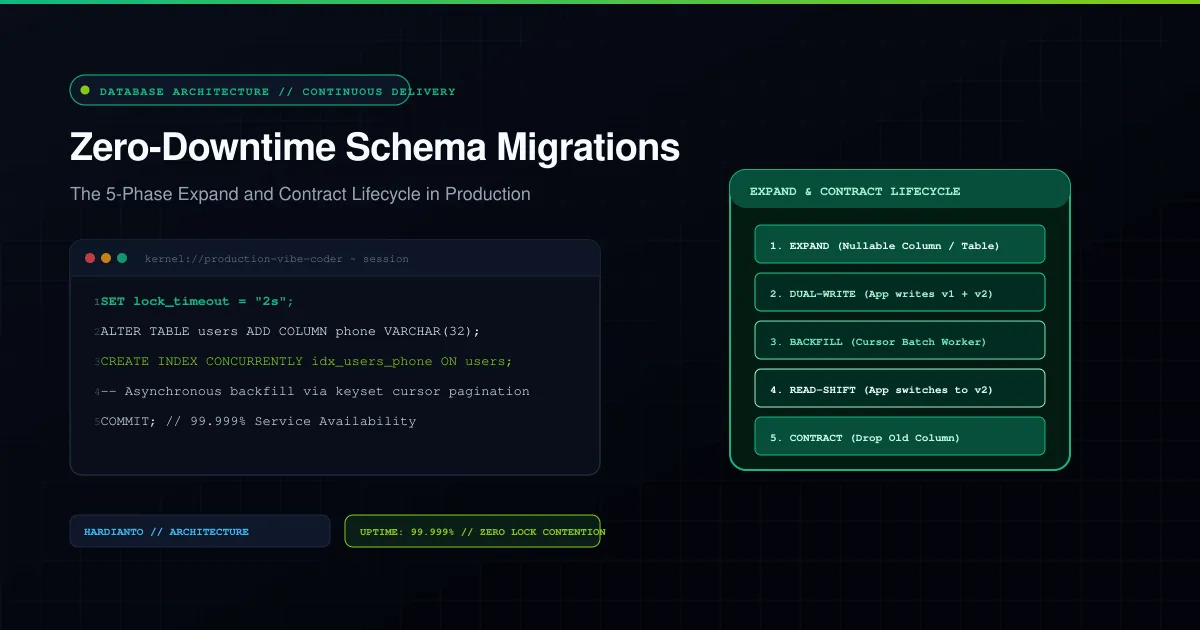
Achieving true zero-downtime schema evolution requires decoupling database schema changes from application code deployments via the Expand-and-Contract (Parallel Run) Pattern.
+-----------------------------------------------------------------------------------+| THE 5-PHASE EXPAND-AND-CONTRACT LIFECYCLE |+-----------------------------------------------------------------------------------+| || Phase 1: EXPAND (Database) || - Add new column/table without NOT NULL constraints or defaults. || - Old app continues reading and writing to old column. || || Phase 2: DUAL-WRITE (Application Deployment v1) || - App writes to BOTH old and new columns. Reads strictly from old column. || || Phase 3: ASYNCHRONOUS BACKFILL (Background Worker) || - Backfill historical rows in small, throttled cursor batches. || || Phase 4: READ SHIFT (Application Deployment v2) || - App switches reads to the new column. Still writes to both for safety. || || Phase 5: CONTRACT (Cleanup) || - Stop writing to old column (Deployment v3). Drop old column from database. |+-----------------------------------------------------------------------------------+1. Safe DDL: Preventing Lock Queue Cascades
By default, PostgreSQL commands like ALTER TABLE wait indefinitely to acquire an ACCESS EXCLUSIVE lock. During this wait, all incoming SELECT queries on that table are queued behind the DDL lock, starving the application.
Always wrap production migrations in tight lock and statement timeouts:
-- Safe migration preambleSET lock_timeout = '2s'; -- If lock cannot be acquired within 2s, fail immediatelySET statement_timeout = '5s'; -- Prevent runaway table rewrites
-- If this fails due to lock timeout, your automated CI/CD pipeline catches it-- and retries later without bringing down production traffic!ALTER TABLE users ADD COLUMN phone_number VARCHAR(32);Adding NOT NULL Columns Safely
In older database versions (pre-Postgres 11), adding a column with DEFAULT and NOT NULL forced a full table rewrite, locking billions of rows for minutes. While modern PostgreSQL optimizes constant defaults as metadata operations, adding NOT NULL without a default still requires validation:
-- STEP 1: Add column nullable (instant metadata operation)ALTER TABLE users ADD COLUMN phone_number VARCHAR(32);
-- STEP 2: Add check constraint marked as NOT VALID (instant: does not scan table)ALTER TABLE users ADD CONSTRAINT chk_phone_not_nullCHECK (phone_number IS NOT NULL) NOT VALID;
-- STEP 3: Validate constraint concurrently (scans rows with SHARE UPDATE EXCLUSIVE: reads/writes proceed!)ALTER TABLE users VALIDATE CONSTRAINT chk_phone_not_null;2. Building Indexes Without Blocking Writes
Executing CREATE INDEX on a 50-million-row table acquires a SHARE lock that blocks all concurrent INSERT, UPDATE, and DELETE transactions until index generation finishes (which can take 30+ minutes).
Always use CONCURRENTLY:
-- Concurrently scans the table twice, allowing live writes to proceed uninterruptedCREATE INDEX CONCURRENTLY idx_users_phone_numberON users (phone_number);Danger (Warning: Concurrent Index Build Failures)
If a CREATE INDEX CONCURRENTLY statement is canceled or encounters a unique constraint violation, it leaves behind an INVALID index in the database. Invalid indexes consume disk I/O and slow down writes while the planner refuses to use them for reads. Always inspect pg_class and drop invalid indexes:
SELECT relname FROM pg_class WHERE relisvalid = false;-- DROP INDEX CONCURRENTLY idx_users_phone_number;3. Asynchronous Batch Backfilling
When migrating data (e.g., splitting a full_name column into first_name and last_name), running an unconstrained UPDATE users SET ... in a single query creates an enormous transaction log (WAL), locks rows, and spikes disk I/O.
Instead, backfill in chunks using cursor pagination with sleep intervals:
# Production zero-downtime backfill script using keyset cursor paginationimport timeimport psycopg2
BATCH_SIZE = 2000SLEEP_DELAY_SECONDS = 0.05
def backfill_users(cursor, connection): last_id = 0 total_processed = 0
while True: # Keyset pagination: O(1) index lookup, avoids slow OFFSET queries cursor.execute(""" SELECT id, full_name FROM users WHERE id > %s ORDER BY id ASC LIMIT %s """, (last_id, BATCH_SIZE))
rows = cursor.fetchall() if not rows: print("Backfill completed successfully.") break
for user_id, full_name in rows: parts = (full_name or "").split(" ", 1) first_name = parts[0] last_name = parts[1] if len(parts) > 1 else ""
cursor.execute(""" UPDATE users SET first_name = %s, last_name = %s WHERE id = %s AND (first_name IS NULL OR last_name IS NULL) """, (first_name, last_name, user_id))
connection.commit() # Commit transaction per batch last_id = rows[-1][0] total_processed += len(rows) print(f"Processed {total_processed} records. Current cursor: {last_id}")
# Cooperative throttling: Give autovacuum and client traffic breathing room time.sleep(SLEEP_DELAY_SECONDS)4. Rollback Compatibility Matrix
A deployment pipeline must ensure that both the previous software version () and the new software version () can run simultaneously against the database schema. This guarantee enables instant, risk-free canary deployments and zero-downtime blue-green rollouts.
Rollback Safety Checklist:+------------------------------------------------------------------------------------+| [Rule 1] Never delete a column in the same deployment that stops reading it. || [Rule 2] Never rename a column directly (always add new -> dual write -> drop). || [Rule 3] All new columns must be nullable or possess an immutable default value. || [Rule 4] Never remove code references until the migration is 100% contracted. |+------------------------------------------------------------------------------------+Summary of Golden Rules
- Guard with
lock_timeout: Never let a DDL operation block for more than 2 seconds. - Always Index
CONCURRENTLY: Build indexes without blocking active OLTP traffic. - Chunk Batch Backfills: Always paginate backfill queries with
LIMITon indexed primary keys and add cooperative sleep intervals. - Follow Expand-and-Contract: Separate database structural expansion from application read-switching across sequential deployment stages.
Recommended for You
Explore more articles on similar topics and continue reading.
PostgreSQL Performance Tuning at Scale: Indexing Strategies, Buffer Cache, and Connection Pooling
Production Kubernetes Hardening: Kernel Observability and Networking with eBPF & Cilium