
The Legacy Networking Tax: Why iptables Fails at Scale
In the early days of Kubernetes, kube-proxy relied on Linux iptables to implement Service routing and virtual ClusterIP resolution. Each service endpoint generated dozens of sequential packet filtering rules in the kernel’s netfilter table.
While functional for 100 pods, this architecture degrades exponentially at scale. When a cluster grows to 5,000 services and 40,000 pods:
- The kernel table swells to over 100,000 sequential rules.
- Every inbound and outbound network packet traverses an
O(N)linear search chain throughiptables. - Updating a single Pod IP forces a complete sequential table dump and rebuild, consuming 100% CPU on worker nodes and inducing latency jitter of up to 40 milliseconds per request.
[Legacy Kube-Proxy with iptables] Packet In -> [PREROUTING] -> [KUBE-SERVICES] -> [Rule 1] -> [Rule 2] ... -> [Rule 85,000] -> Pod * Complexity: O(N) linear scan | CPU Thrashing on frequent Pod restarts
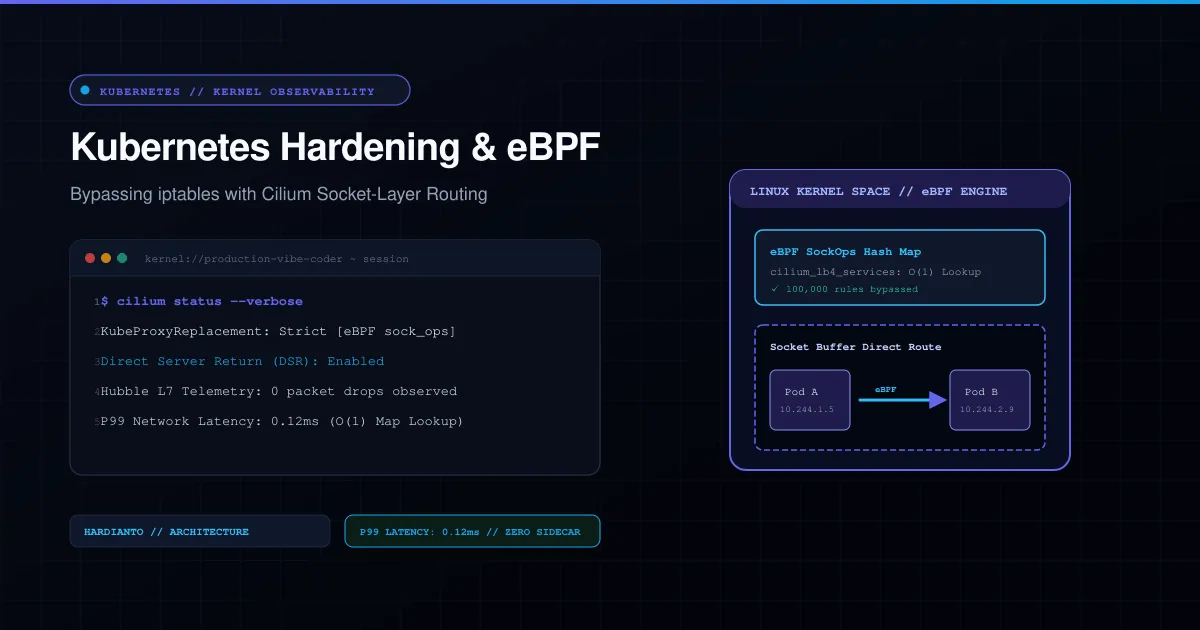
[Modern Cilium with eBPF Socket-Layer Routing] Packet In -> [eBPF XDP / TC Program] -> [B-Tree Map Lookup: O(1)] --------> Destination Pod Socket * Complexity: O(1) hash map lookup | 300% higher packet throughput | Zero iptables traversalExtended Berkeley Packet Filter (eBPF) changes this paradigm by running sandboxed byte-code programs directly inside the Linux kernel in response to tracepoints, network sockets, and XDP (eXpress Data Path) hooks.
1. Replacing Kube-Proxy with Cilium eBPF
By replacing kube-proxy completely with Cilium, packet routing bypasses the TCP/IP stack overhead entirely. When two pods communicate on the same physical node, Cilium hooks directly into the kernel’s socket layer (sock_ops), writing bytes directly between socket buffers:
# Helm installation: Deploying Cilium in pure kube-proxy replacement modehelm install cilium cilium/cilium --version 1.16.0 \ --namespace kube-system \ --set kubeProxyReplacement=true \ --set k8sServiceHost=10.0.0.10 \ --set k8sServicePort=6443 \ --set bpf.masquerade=true \ --set bpf.tproxy=true \ --set autoDirectNodeRoutes=true \ --set hubble.relay.enabled=true \ --set hubble.ui.enabled=true \ --set loadBalancer.mode=dsrDirect Server Return (DSR) Optimization
In standard Kubernetes load balancing, traffic returning from a pod travels back through the load balancer node before reaching the client, introducing asymmetric bandwidth bottlenecks.
Under Cilium’s Direct Server Return (DSR), the backend pod preserves the client’s original IP and sends the return response packets directly to the client gateway, doubling inbound ingress bandwidth capacity:
[External Client] <---------------------------------------------+ | | v (Request) | (Response Direct)+-----------------------+ eBPF Encapsulated Forward || Edge Load Balancer | -----------------------------> +---------------+| (Cilium Node 1) | | Backend Pod |+-----------------------+ | (Node 2) | +---------------+2. Kernel-Enforced Layer 7 Zero-Trust Network Policies
Standard Kubernetes NetworkPolicy primitives operate strictly at Layer 3 (IP) and Layer 4 (Port). They cannot distinguish between a legitimate GET /public/health request and a malicious POST /admin/delete-database command over the same HTTP port 8080.
With Cilium eBPF, we enforce granular Layer 7 security rules directly in the kernel without injecting memory-heavy sidecar proxies into every application pod:
apiVersion: "cilium.io/v2"kind: CiliumNetworkPolicymetadata: name: "secure-order-service-l7" namespace: "production"spec: endpointSelector: matchLabels: app: "order-service" ingress: # Rule 1: Allow API Gateway only specific REST paths - fromEndpoints: - matchLabels: app: "api-gateway" toPorts: - ports: - port: "8080" protocol: TCP rules: http: - method: "GET" path: "/v1/orders/[a-zA-Z0-9-]+" - method: "POST" path: "/v1/orders" # Rule 2: Strictly deny all access to /metrics from external pods egress: # Rule 3: Allow Payment Service strictly over HTTPS to external gateway - toFQDNs: - matchName: "api.stripe.com" toPorts: - ports: - port: "443" protocol: TCPTheorem (Kernel vs Sidecar Performance)
Sidecar proxies (such as Envoy in traditional service meshes) require two complete context switches and TCP socket re-encapsulations for every hop (Client Pod -> Host Net -> Sidecar -> Physical NIC -> Sidecar -> Target Pod). Cilium eBPF enforces L7 filtering inside kernel memory, achieving up to a 75% reduction in P99 network latency.
3. Pod Disruption Budgets (PDB) & Graceful Draining
A primary cause of production outages during cluster upgrades and node autoscaling is reckless node draining. When Kubernetes evicts pods simultaneously, database connection spikes, cache misses, and 502 Bad Gateway errors cascade across upstream services.
To ensure resilience, every production deployment requires a tightly calibrated Pod Disruption Budget (PDB) paired with proper container lifecycle termination hooks:
apiVersion: policy/v1kind: PodDisruptionBudgetmetadata: name: order-service-pdb namespace: productionspec: minAvailable: "80%" # Never allow more than 20% of replicas to be offline selector: matchLabels: app: order-serviceImplementing Graceful Shutdown in Application Deployments
apiVersion: apps/v1kind: Deploymentmetadata: name: order-service namespace: productionspec: replicas: 10 strategy: type: RollingUpdate rollingUpdate: maxSurge: 25% maxUnavailable: 0 # Zero downtime guaranteed during rollouts template: metadata: labels: app: order-service spec: terminationGracePeriodSeconds: 45 containers: - name: app image: registry.internal/order-service:v2.4.1 lifecycle: preStop: exec: # 1. Sleep gives Kubernetes endpoints-controller time to withdraw IP from kube-proxy # 2. Application continues serving inflight transactions before receiving SIGTERM command: ["/bin/sh", "-c", "sleep 10"] readinessProbe: httpGet: path: /ready port: 8080 initialDelaySeconds: 5 periodSeconds: 3 failureThreshold: 2 resources: requests: cpu: "1000m" memory: "2Gi" limits: cpu: "2000m" memory: "4Gi"4. Kernel Observability with Hubble and eBPF Tracing
Debugging intermittent network drops in Kubernetes usually degrades into futile tcpdump sessions inside transient containers. Cilium’s Hubble uses eBPF to capture every TCP handshake, connection reset, DNS lookup failure, and HTTP response code with zero application instrumentation:
# Observe real-time dropped packets across all pods in productionhubble observe --follow \  --namespace production \  --verdict DROPPED
# Track all DNS queries and resolution latencyhubble observe --type dns \  --namespace production
# Inspect raw eBPF socket maps in the Linux kernelsudo bpftool map dump name cilium_lb4_services_v2
5. Linux Kernel Sysctl Tuning for High-Concurrency Nodes
Default Linux kernel socket parameters are tuned for generic desktop and small server environments. For nodes running thousands of concurrent microservice connections, apply these production sysctls via a Kubernetes DaemonSet or node image builder:
# Increase max pending socket connections for high-volume burstsnet.core.somaxconn = 32768net.ipv4.tcp_max_syn_backlog = 16384
# Enable TCP BBR congestion control for lower packet retransmission latencynet.core.default_qdisc = fqnet.ipv4.tcp_congestion_control = bbr
# Expand local ephemeral port range for outbound API callsnet.ipv4.ip_local_port_range = 10240 65535
# Fast recycling of TIME_WAIT sockets safelynet.ipv4.tcp_tw_reuse = 1net.ipv4.tcp_fin_timeout = 15
# Increase inotify user watches for large container volume mountsfs.inotify.max_user_watches = 524288fs.inotify.max_user_instances = 8192Summary Checklist for Production Readiness
- Eliminate iptables Overhead: Migrate clusters to Cilium in pure
kubeProxyReplacementmode. - Lock Down L7 Egress: Prevent supply-chain credential exfiltration by whitelisting outbound FQDNs.
- Mandate Pod Disruption Budgets: Set
maxUnavailable: 0during rolling updates andminAvailable: 80%on PDBs. - Use PreStop Sleep Delays: Add a 10-second
preStophook so service mesh endpoints detach gracefully before processes receiveSIGTERM.
Recommended for You
Explore more articles on similar topics and continue reading.