
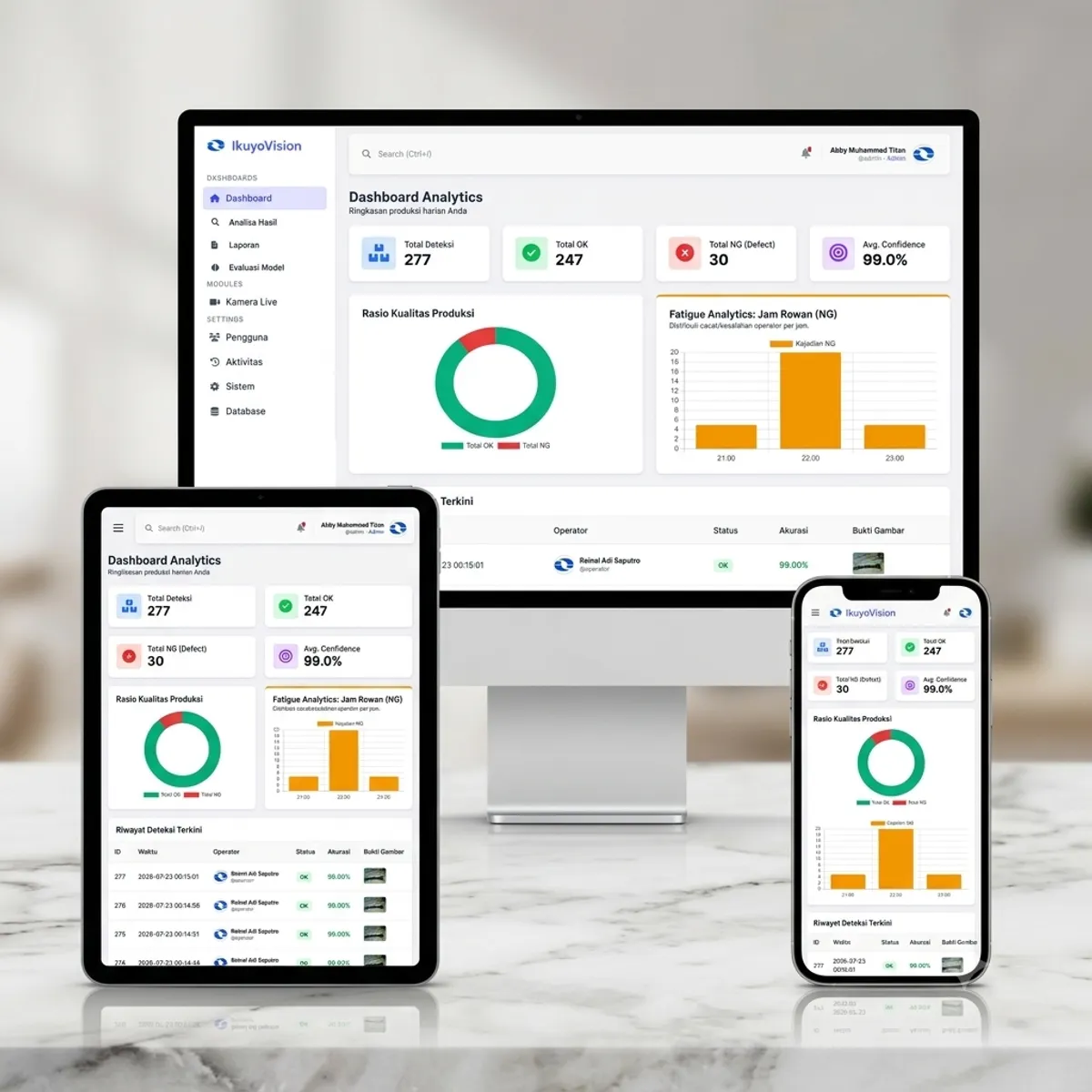
🏛️ System Overview & Engineering Highlights
Ikuyo Vision is an automated industrial inspection platform engineered for high-accuracy child part verification on manufacturing assembly lines. The system unites real-time edge deep learning inference with asynchronous stream processing to maintain sub-millimeter precision under variable factory lighting and continuous vibration.
🎯 Key Technical Deliverables & Achievements
- Low-Light Neural Optimization: Designed low-light image processing pipelines, accelerating bounding box generation by 35%.
- Real-Time Defect Detection: Developed a real-time defect detection system with 98% accuracy, reducing factory inspection miss rates to under 0.5%.
- Edge Database Acceleration: Deployed an optimized database architecture, accelerating dynamic dashboard rendering by 50%.
- Temporal Voting Stabilization: Integrated a multi-frame history voting algorithm into live streams, decreasing false alarms by 25%.
- Throughput & Concurrency Tuning: Optimized API endpoints and database connection pooling, increasing concurrent throughput by 25%.
- High-Throughput Storage Layer: Built an asynchronous file storage layer, eliminating disk write bottlenecks and lowering image saving latency by 30%.
🔬 Deep-Dive Technical Implementation
1. Low-Light Vision & Bounding Box Acceleration
- Implemented adaptive contrast enhancement, color-space filtering (HSV/LAB), and morphological gradient transformations via OpenCV.
- Optimized the neural inference input tensors for YOLOv5, reducing GPU/CPU memory copying overhead and achieving a 35% speedup in bounding box generation.
2. Real-Time Defect Detection & History Voting
- Developed custom classification heads specialized in microscopic child part defects (dimensional deviations, surface anomalies, missing sub-components).
- Integrated a multi-frame history voting algorithm that buffers spatial detections across consecutive video frames, suppressing momentary noise and slashing false alarms by 25% while keeping miss rates below 0.5%.
3. Asynchronous I/O & Low-Latency File Storage
- Engineered an asynchronous worker queue for high-resolution defect snapshots, offloading disk I/O from the critical inference thread.
- Eliminated disk write blocking, reducing image storage latency by 30% during continuous line operations.
4. Database Optimization & Telemetry Dashboard
- Configured SQLite3 edge indexing and implemented connection pooling in Flask, enabling concurrent queries under heavy inspection throughput.
- Increased overall API throughput by 25% and sped up real-time analytics dashboard rendering by 50%.
🛠 Technology Stack Matrix
| Domain | Technologies Used |
|---|---|
| Computer Vision & AI | YOLOv5 (PyTorch), OpenCV, Bounding Box Regression, Temporal Voting Algorithms |
| Edge Backend & APIs | Python 3, Flask, Asynchronous I/O Workers, Thread Pooling |
| Data Storage & Indexing | Edge-Optimized SQLite3, Connection Pooling, Structured Audit Logging |
| DevOps & Deployment | Docker Containerization, Linux Edge PCs, CI/CD Automated Testing |
📊 Performance Benchmarks & Impact
- 98% Detection Accuracy: Consistently validated across diverse production line batches.
- < 0.5% Miss Rate: Drastically outperforming manual visual inspection standards.
- 35% Faster Localization: Real-time bounding box coordinate generation under fluctuating illumination.
- 50% Faster Dashboard Rendering: Rapid metric querying and defect heatmap visualization for line managers.
- 30% Reduced Image Saving Latency: Non-blocking asynchronous file persistence.
- 25% Higher Concurrency: Optimized connection pooling supporting multiple synchronized inspection points.