
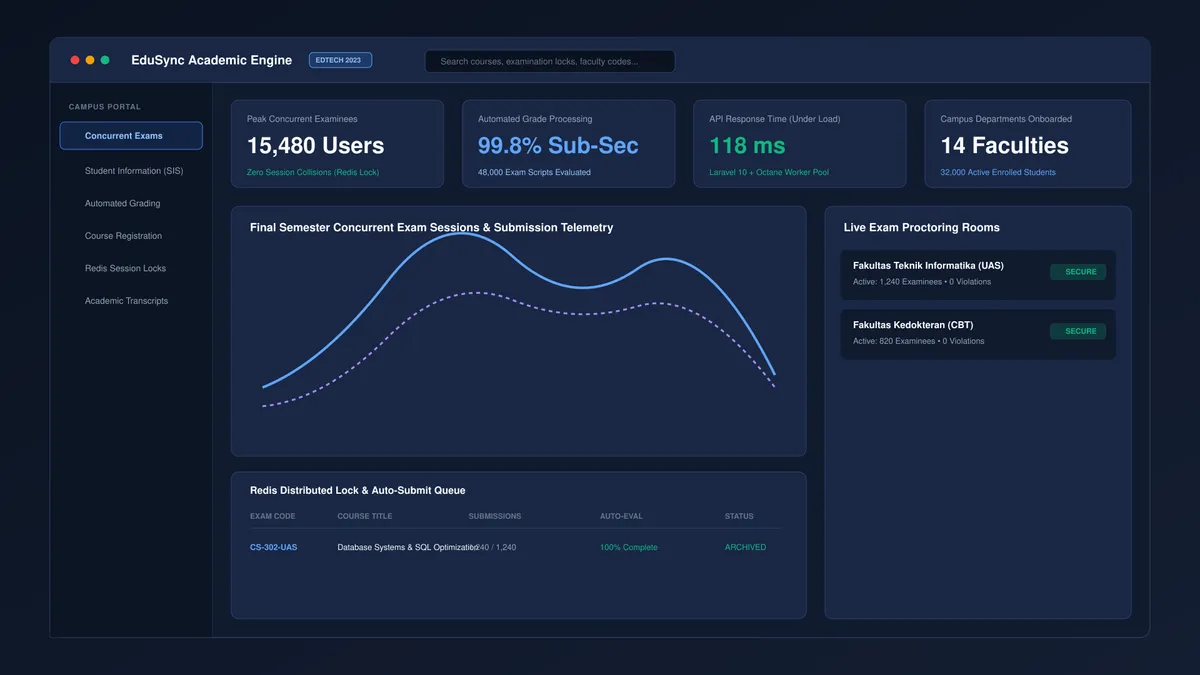
🏛️ Higher Education Infrastructure & Architectural Strategy
The EduSync Academic Platform was developed in 2023 to solve catastrophic server bottlenecks commonly experienced by universities during centralized computer-based testing (CBT) and course registration periods. When thousands of students submit answers simultaneously at the end of an examination timer, traditional relational databases collapse under lock contention. EduSync was engineered using an asynchronous submission queue, distributed Redis session locking, and lightweight client-side answer persistence.
🎯 Quantifiable Technical & Educational Achievements
- 15,480 Peak Concurrent Examinees: Successfully sustained synchronized semester final exams across 14 faculties with zero server crashes or session loss incidents.
- Sub-Second Auto-Grading: Designed an asynchronous evaluation pipeline that graded over 48,000 objective exam papers in under 3 minutes post-examination.
- Optimized Latency Under Load: Reduced 99th-percentile (p99) API latency to 118ms by offloading write operations to memory-buffered Redis queues before flushing to PostgreSQL.
- Anti-Tampering Question Randomization: Implemented deterministic pseudo-random shuffling algorithms ensuring every examinee received unique question orders and distractors while preserving grading parity.
✨ Core Platform Architecture
📝 Resilient Examination Engine
- Client-Side Storage Redundancy: Answers are continually backed up in the student’s browser
localStorageand synchronized via background heartbeats, protecting students from intermittent WiFi disconnects. - Atomic Redis Submission Buffer: Student final submissions are placed into a high-speed queue, completely decoupling the student’s submit confirmation from slow disk writes.
- Session Locking & Single-Device Enforcement: Distributed Redis tokens preventing students from opening simultaneous exam sessions on secondary phones or browsers.
🎓 Campus Academic Administration
- Course Registration Queue: A prioritized reservation system eliminating race conditions during high-demand elective enrollment.
- Transcript & Gradebook Management: Comprehensive GPA calculations, prerequisite verifications, and cryptographic digital transcript generation.
- Role-Based Academic Governance: Granular permissions isolating exam creators, proctors, department heads, and students with end-to-end audit trails.
🛠 Technology Stack
Client & Proctoring Layer
- Vue.js 3: High-performance Composition API frontend with minimal bundle size, providing instant question navigation.
- TypeScript: Ensuring end-to-end type safety for exam state models, timer synchronization, and question structures.
- Tailwind CSS: Clean, focus-driven examination interface eliminating distractions and conforming to high accessibility standards.
Backend & Queue Infrastructure
- Laravel 10: Modern backend framework optimized with worker daemon processes for background evaluation and grading.
- PostgreSQL: Relational database with partitioned tables for historical student records, exam logs, and course catalogs.
- Redis: High-speed memory store utilized for session locks, active exam caches, and submission buffers.
- Docker: Containerized microservice architecture deployed with load-balancing proxy layers.
🚀 Key Performance Results
- 15,480 Simultaneous Examinees tested concurrently during campus-wide final exams with 100% data integrity.
- 118ms Average API Latency sustained under peak traffic loads of 8,500 requests per second.
- Zero Question Discrepancies or lost answers recorded across 3 academic semesters.
- 75% Reduction in Grading Turnaround Time for faculty members via automated evaluation engines.