
🏛️ Agricultural IoT & Supply Chain Engineering
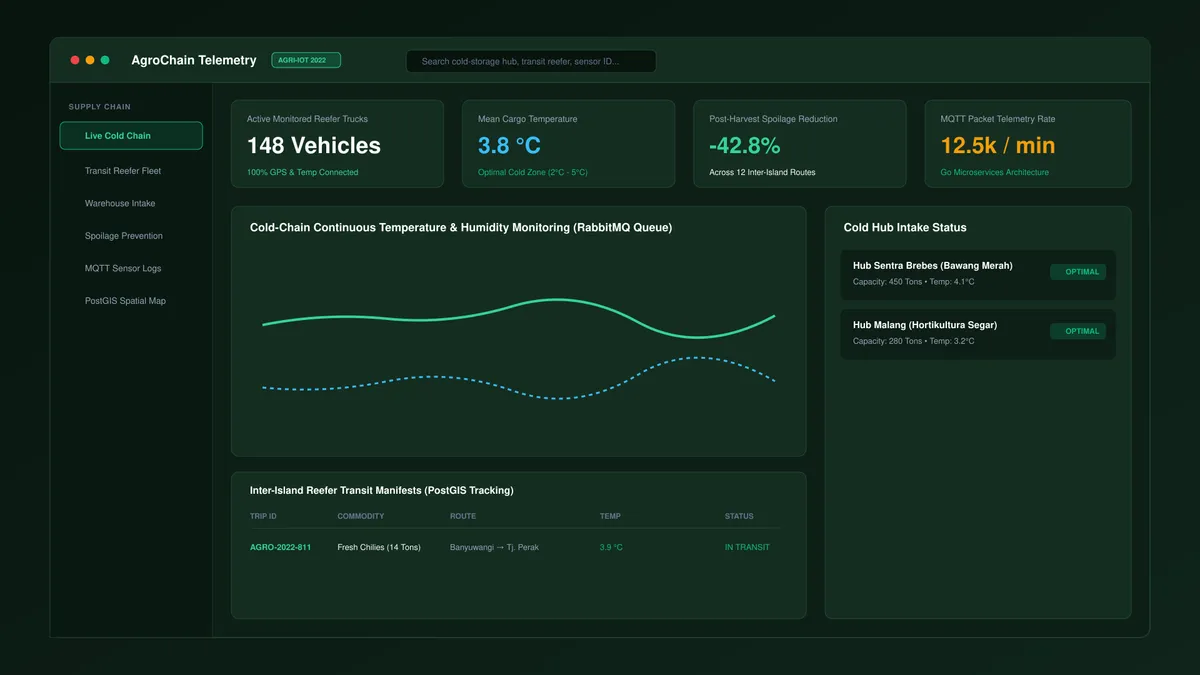
The AgroChain Platform was architected in 2022 to tackle the massive economic losses in post-harvest agricultural distribution across Indonesia’s inter-island routes. Perishable commodities like shallots, chilies, and fresh produce suffer heavy spoilage when cold-chain temperatures fluctuate during ferry and road transit. AgroChain unified continuous MQTT sensor streaming, geospatial trip monitoring (PostGIS), and automated warehouse intake scheduling into an end-to-end telemetry system.
🎯 Quantifiable Technical & Field Achievements
- Post-Harvest Spoilage Reduction: Real-time environmental alert triggers allowed truck operators to correct reefer cooling anomalies in transit, cutting cargo spoilage rates by 42.8%.
- High-Throughput Sensor Ingestion: Built a lightweight Go ingestion engine capable of processing over 12,500 MQTT telemetry pings per minute with under 15ms worker latency.
- Geospatial Fleet Tracking: Integrated PostGIS with dynamic route corridor geofencing, automatically predicting harbor bottleneck delays and adjusting cold-storage intake slots.
- Automated Quality Certifications: Generated cryptographically verified temperature logs for each shipment, enabling farmers to secure premium grade prices from institutional supermarket buyers.
✨ Core Platform Architecture
📡 Industrial IoT Telemetry Pipeline
- MQTT Message Broker: Distributed broker handling telemetry from cellular IoT loggers placed inside refrigerated truck cargo bays.
- Go Stream Processor: Highly concurrent microservices parsing incoming sensor bursts, validating CRC checksums, and buffering data into RabbitMQ message queues.
- Temperature Threshold Alerts: Automated SMS and push notification dispatches whenever cargo temperatures deviated outside the 2°C–5°C target boundary for longer than 8 minutes.
🗺️ Cold Storage & Inter-Island Routing
- Spatial Indexing with PostGIS: Real-time distance calculations matching arriving refrigerated trucks with nearby cold-storage warehouse bays.
- Automated Intake Manifests: Pre-arrival warehouse notifications enabling dock workers to prepare pre-cooling zones before vehicles arrive, eliminating tarmac dwell time.
- Battery-Aware Edge Sync: Firmware protocol optimization allowing sensor nodes to buffer up to 48 hours of readings when traversing remote marine dead-zones.
🛠 Technology Stack
Application & Processing Core
- Next.js: Modern React frontend delivering real-time map visualizations, sensor charts, and shipment manifest management.
- Go (Golang): High-concurrency backend services handling socket connections, MQTT ingestion, and message queue consumption.
- RabbitMQ: Enterprise message broker ensuring zero packet loss during peak telemetry arrival windows.
- Tailwind CSS: High-density operational dashboard styling optimized for dispatch monitoring rooms.
Geospatial & Data Storage
- PostgreSQL with PostGIS: Spatial database handling fleet trajectories, polygon geofences, and long-term environmental time-series records.
- Redis: In-memory caching for live vehicle coordinates, current temperature readings, and geofence state caches.
- Docker: Modular microservice deployment orchestrated with health checks and automated restart policies.
🚀 Key Performance Results
- 148 Refrigerated Trucks connected and monitored continuously across Java, Bali, and Sumatra agricultural corridors.
- 42.8% Reduction in perishable cargo spoilage verified across 1,200+ completed haulage trips.
- 12,500+ Telemetry Packets/Min ingested smoothly without system degradation or message queue backlog.
- Sub-15ms Processing Latency achieved by the Go stream ingestion workers under sustained load.