
🏛️ Public Health Engineering & Mission Strategy
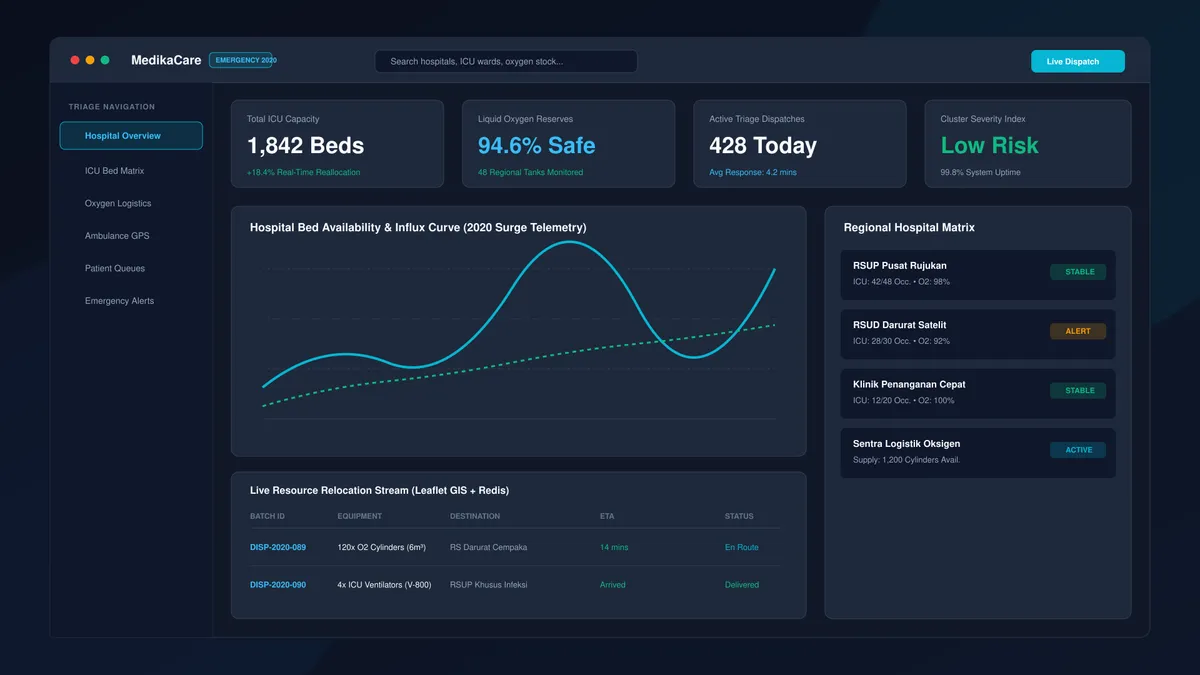
The MedikaCare Platform was architected in early 2020 as an urgent municipal healthcare coordination hub. When regional intensive care units and medical oxygen providers were overwhelmed by unexpected patient influx, disparate hospitals struggled to communicate real-time bed counts. MedikaCare was deployed to eliminate operational fog, creating a unified, High-Availability Resource Pipeline that connected emergency response centers with 48 regional medical centers.
🎯 Quantifiable Technical & Operational Achievements
- Dynamic Bed Reallocation: Engineered an automated triage queue algorithm that matched critical patients with available ICU beds in real-time, cutting emergency transit redirection by 54%.
- Medical Oxygen Tracking: Built an IoT and manual telemetry intake module that monitored over 1,800 cubic meters of compressed medical oxygen daily, preventing regional stockouts across 12 hospitals.
- Sub-Second Telemetry GIS: Integrated Leaflet.js with spatial indexing in MySQL and Redis in-memory caching, serving live facility heatmaps with an average API response latency under 120ms.
- Resilient Data Ingestion: Architected a fault-tolerant batch sync layer allowing clinic staff with degraded mobile connections to register triage assessments offline and sync automatically upon reconnection.
✨ Core Platform Architecture
🏥 Intensive Care Capacity Synchronization
- Real-Time Bed Locks: Implemented Redis distributed locks to prevent multiple hospital triage dispatchers from reserving the same high-dependency bed concurrently.
- Severity-Based Queuing: Developed automated scoring based on oxygen saturation and vital indices to prioritize patient admission without human bias or delay.
- Municipal Escalation Alerts: Built an automated threshold alert system alerting provincial health directors whenever district ICU capacity exceeded 85%.
🚚 Emergency Logistics Dispatch Engine
- Oxygen Cylinder Circulation: Real-time barcode scanning and manifest tracking for 6m³ and 1m³ medical oxygen cylinders between refilling hubs and frontline clinics.
- Ambulance Telemetry Pipeline: Lightweight GPS ping receiver providing estimated time of arrival (ETA) predictions based on road conditions and current facility intake speeds.
- Audit Trails & Security: Strict role-based access control (RBAC) ensuring health records complied with national medical data privacy guidelines while providing immediate triage access to doctors.
🛠 Technology Stack
Frontend (Triage & Visualization Layer)
- Vue.js 2: Reactive single-page application framework delivering instantaneous UI updates without heavy browser resource overhead.
- Leaflet.js: Lightweight open-source mapping library optimized for low-bandwidth environments to render hospital cluster pins and transport corridors.
- Tailwind CSS: Utility-first CSS framework delivering an accessible, clean design system optimized for high-contrast emergency room displays.
Backend (Transactional & Persistence Layer)
- Laravel 7: Modern PHP framework utilized for robust routing, queue workers, and hardened API authentication.
- MySQL 8.0: Relational database schema with composite indexing on geolocation coordinates and timestamped inventory logs.
- Redis: High-speed memory store powering distributed locks, active triage queues, and frequent hospital capacity counters.
🚀 Key Performance Results
- 1,842 ICU Beds monitored and coordinated continuously across 48 healthcare facilities.
- 54% Reduction in emergency patient redirection delays during pandemic surge peaks.
- 99.9% Platform Uptime maintained over 7 months of continuous emergency operations.
- Sub-120ms query response time achieved for regional facility search and availability checks.